Violin
Violin Lessons in Singapore: A Guide for Beginners, Kids, and Adults
Few instruments command the same kind of attention as the violin. There is something about its silhouette, its history, and the sheer emotional range of its sound that draws people in and intimidates them in equal measure. In Singapore, interest in violin lessons has remained remarkably steady, with new parents, teenagers, and even working adults signing up every year.
If you are exploring violin lessons in Singapore, this guide will walk you through what to expect, when to begin, which method to choose, how much it costs, and how to find a teacher who will help you (or your child) genuinely fall in love with the instrument.
We have written this guide with two readers in mind. The first is a parent considering the violin for their child for the first time and wondering whether it is realistic. The second is an adult who has always quietly wanted to play and is finally giving themselves permission to do so. The honest answer for both readers is the same: yes, it is realistic, provided you set up the right conditions. The rest of this guide is about those conditions.
Why Violin Lessons Are a Rewarding Investment in Singapore
The violin is not a casual instrument. It rewards patience, precision, and consistent practice in a way few others do, and that is exactly why students who stay with it tend to develop deep musicianship and strong focus.
- Tone is built, not bought. Unlike a piano key, the violin has neither frets nor a preset tuning. Every note is shaped by your fingers and bow, which trains a kind of attention to detail that transfers far beyond music.
- It thrives in ensembles. Orchestras, chamber groups, school strings programs, and church ensembles all need violinists, opening up community and collaboration as soon as basic skills are in place.
- It travels well. A violin fits in an overhead bin. The piano does not.
There is a fourth reason families choose the violin specifically: its place in school and community ensembles in Singapore. String programs are well-established in international and local schools, the Singapore Symphony Orchestra runs strong outreach programs, and there are well-supported youth orchestras, chamber groups, and church string ensembles across the island. A child who learns the violin almost always has somewhere to play with others, and that ensemble experience is one of the great long-term joys of being a string player.
What Makes the Violin Unique Among Stringed Instruments
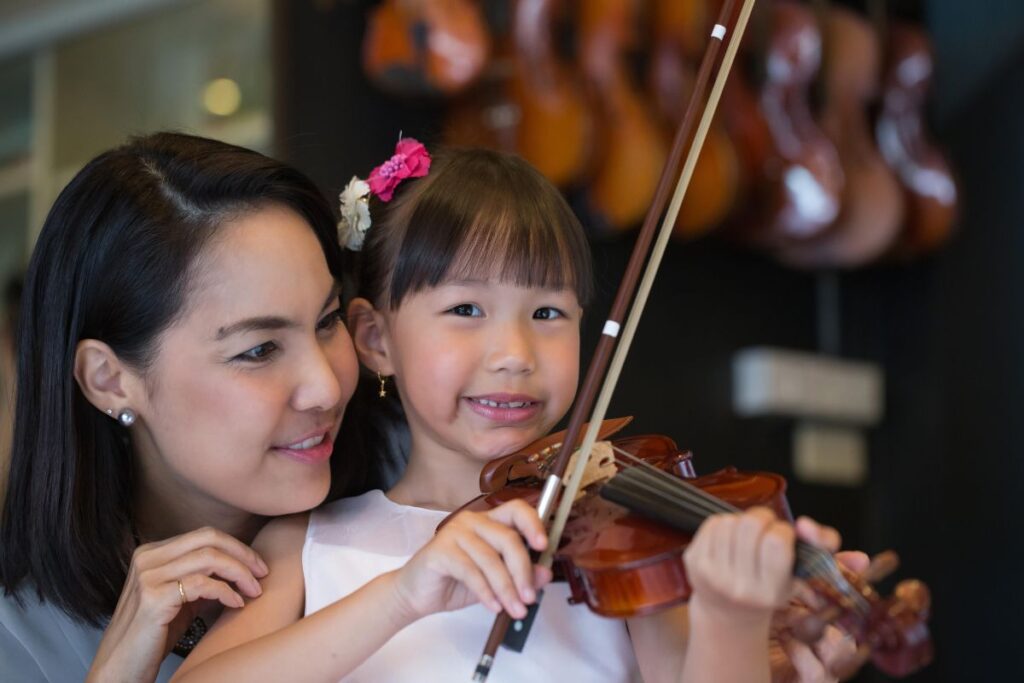
The violin sits at the heart of the string family. Its smaller cousin, the viola, is tuned a fifth lower and has a richer middle voice. The cello and double bass serve as the bass line. Among them all, the violin is most often the melodic leader.
For beginners, the violin’s main challenge, and gift, is that there is no shortcut to sound. You have to learn to listen, adjust, and refine. The students who embrace this find that the violin teaches them how to learn anything else more carefully.
It is also worth knowing that the violin and viola share most of their playing technique. Students who start on violin can switch to viola later, and many adult students do exactly that, drawn by the deeper, warmer tone. Some of our most committed students play both instruments, depending on the ensemble or the repertoire.
Is the Violin Hard to Learn? An Honest Singaporean View
Yes, and that is not a reason to avoid it. The first six to twelve months of violin study are objectively harder than the first six months on most other instruments. Bow control, left-hand finger placement, intonation, posture, and reading music all occur simultaneously. Without a patient teacher and a supportive home environment, students can get discouraged.
That said, the difficulty is front-loaded. Once the fundamentals are in place, progress can be rapid and deeply satisfying. The students who succeed are not the most naturally talented; they are the ones whose families and teachers stay calm through the early months.
A useful rule of thumb: judge progress monthly, not weekly. Some weeks will feel like treading water, especially as the body continues to adapt to bow holds and finger placement. Zoom out to a month-on-month view and the picture usually looks very different: a child who could not hold the bow steadily in January is producing real, audible musical phrases by April. That is normal.
Violin Lessons for Children: The Right Age to Begin
Children can begin violin lessons earlier than most parents expect. Suzuki-trained teachers commonly work with students from age four, and some begin as early as three. For non-Suzuki approaches, ages five to seven are typical.
What matters more than the calendar age is whether the child is ready:
- Can they sit or stand still and focus for at least fifteen minutes?
- Can they follow gentle physical instructions about posture and hand position?
- Are they showing genuine curiosity about music or about the violin specifically?
- Is at least one parent willing to be involved at home, especially in the first year?
That last point is non-negotiable for very young learners. Children under seven rarely practice well on their own. A parent who can sit with the child for a short, supportive practice session each day is one of the strongest predictors of long-term success.
Parents new to the violin sometimes hear that they need to commit to twenty or thirty minutes of practice a day from day one. That is not quite right. For a five-year-old, five to ten focused minutes is plenty. The point at this age is not duration but consistency; practicing six days a week for five minutes will outperform two thirty-minute marathons. Frequency builds muscle memory; duration only matters once attention and stamina catch up, usually around ages eight to ten.
Violin Lessons for Teens: Building Tone, Technique, and Confidence
Teenage violinists are often working at intermediate to advanced levels and are well placed to take on serious repertoire, ABRSM or Trinity exams, and ensemble work in school strings or community orchestras. The biggest variables at this stage are time and motivation.
A good teacher for a teen knows when to push and when to back off, and helps the student choose repertoire that genuinely excites them, not just the next graded piece on a list.
Violin Lessons for Adults: A Realistic and Rewarding Path
Adult beginners are sometimes told the violin is too hard to pick up later in life. That is not our experience. Adults bring focus, patience, and clear motivation, qualities most children are still developing. The trade-off is that adult bodies are less flexible and adult schedules are more crowded.
Adult violin students typically aim for one or more of the following:
- Learning to play favorite folk, classical, or film pieces at a recreational level.
- Returning to the violin after stopping during school years.
- Joining a community orchestra or chamber group.
- Building a creative habit that has nothing to do with their day job.
Suzuki vs Traditional Method: Which Suits Your Child Best
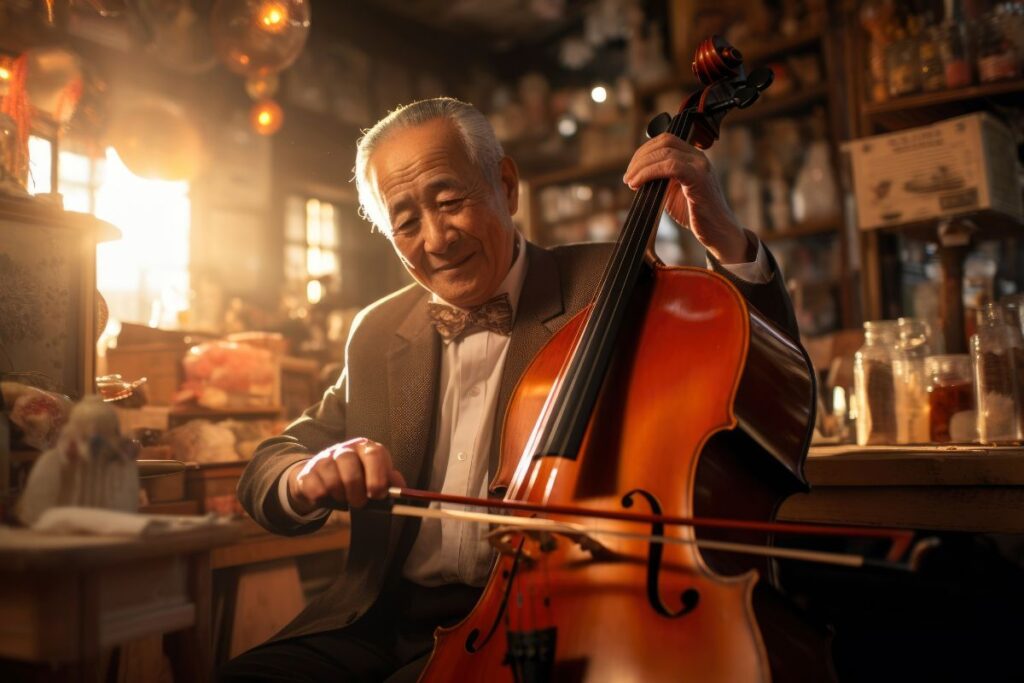
Two main approaches dominate violin teaching in Singapore. Both can produce excellent musicians; the right one depends on the family and the child.
- The Suzuki method emphasizes listening, imitation, and parental involvement. Children learn pieces by ear before reading them, and the parent often attends lessons and supports daily practice.
- The traditional/classical method introduces reading earlier, builds technique through scales and etudes, and is often preferred for older starters or students aiming at a more conventional exam pathway.
Many experienced teachers, including ours, blend the two, using Suzuki ear training and tone work in the early years before transitioning to a fuller classical curriculum.
Both methods, importantly, work, and both can produce world-class musicians. The deciding factor is usually the family’s appetite for involvement and the child’s learning style. A child who learns best by watching and copying will thrive in a Suzuki environment. A child who is naturally drawn to reading and structured analysis may prefer a traditional approach. There is no wrong answer, only a better fit.
Choosing Your First Violin and Bow
A poorly set-up beginner violin can frustrate even the most committed student. A rough or unresponsive sound is not always the player’s fault; sometimes, the instrument is the problem. Before purchase, get advice from your teacher or a trusted luthier.
- Size matters. Children move through fractional sizes (1/16 up to 4/4) as they grow. A violin that is the wrong size causes posture problems and slows progress.
- Set-up matters more than brand. A modestly priced violin properly set up by a luthier will outperform a fancy-looking online purchase that hasn’t.
- Bow choice is half the sound. Many beginners underestimate this. A balanced, responsive bow makes tone production noticeably easier.
Group vs Private Violin Lessons in Singapore
Group classes can be a good social entry point, especially Suzuki group lessons, but the core of violin training is one-on-one. Tone, intonation, and posture cannot be taught in groups beyond the very early stages.
- Group lessons are useful for ensemble experience, peer-driven motivation, and lower-cost early exposure.
- Private lessons are necessary for technique correction, exam preparation, intermediate and advanced study, and adult learners.
ABRSM and Trinity Violin Exams: What Parents Should Know
Both ABRSM and Trinity College London offer graded violin examinations recognized globally. Both have their advantages, and both can build strong musicians.
- ABRSM is the most familiar route for Singaporean families and is widely accepted as a benchmark of progress.
- Trinity offers slightly more flexibility in repertoire and an alternative marking emphasis that some students find more constructive.
Exams are useful checkpoints, but they should not become the only reason to play. A thoughtful teacher will use exams to anchor steady progress without letting the syllabus crowd out the joy of the instrument.
How Much Do Violin Lessons Cost in Singapore?
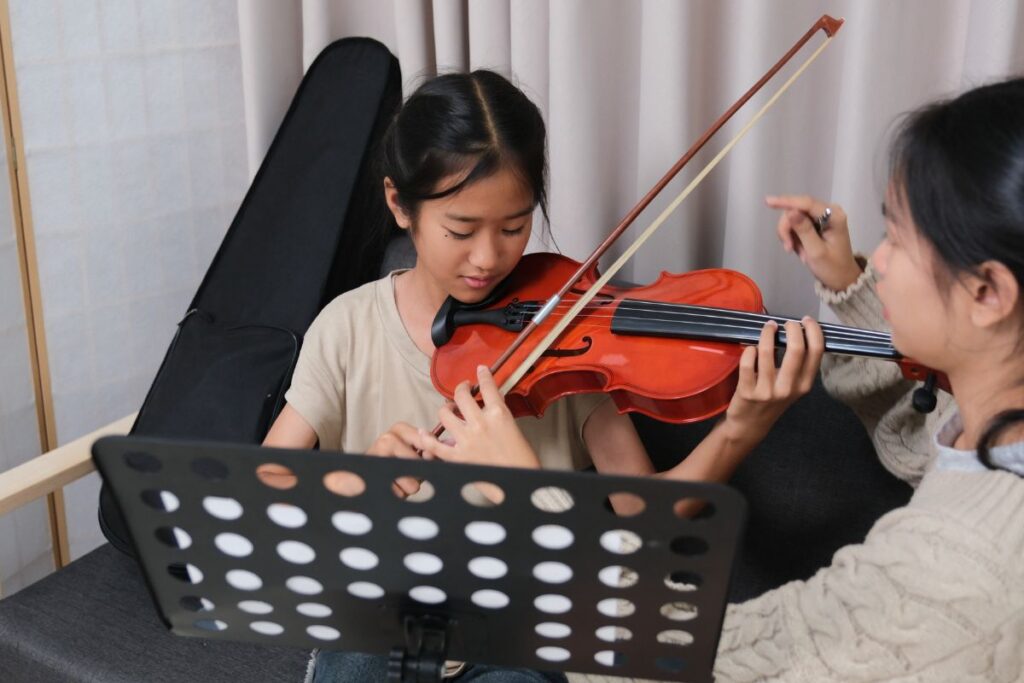
Violin lesson fees in Singapore depend on lesson length, teacher experience, location, and whether the lesson is private or group. As a general expectation, plan for a monthly fee that includes weekly lessons, plus additional costs for the instrument, books, exam registrations where applicable, and occasional bow rehairs.
- A starter outfit (violin, bow, case, rosin) is your initial outlay.
- Children’s instruments will need to be upgraded as they outgrow each fractional size.
- Bow rehairs are needed roughly every twelve to eighteen months for active students.
Finding the Right Violin Teacher and School
A great violin teacher is part technician, part diplomat, part coach. Look for someone who can demonstrate clearly, listen carefully, and adjust their language to a four-year-old or a forty-year-old without losing patience.
- Ask about teaching method (Suzuki, traditional, or blended).
- Ask about experience with the age group you are enrolling.
- Ask how the teacher communicates with parents, especially for younger students.
- Ask about make-up lesson policy, term structure, and how recitals or performance opportunities are handled.
If possible, observe a lesson; many quality schools welcome this for prospective families.
Building a Practice Routine That Actually Works
The violin punishes inconsistent practice more than most instruments. Five short sessions a week will outperform one long Sunday session, every time.
- Begin every session with a few minutes of tuning, a posture check, and slow scales; these are the instrument’s muscle warm-ups.
- Practice difficult passages slowly. Speed is a side effect of accuracy, not the other way around.
- Record yourself once a week. Even a phone recording reveals tone, rhythm, and intonation issues you cannot hear in the moment.
- End each session with something you enjoy playing; a small daily reward keeps motivation alive.
Violin Lessons in Bukit Timah and Across Singapore
Bukit Timah has long been a quiet center for serious music study in Singapore, partly because of its concentration of established music schools and partly because its leafy, low-density character makes it pleasant to walk into a studio without the friction of a shopping mall environment. For families across the rest of the island, the right violin school is usually the one whose weekly commute you can sustain. Consistency in attendance, week after week, term after term, is one of the strongest predictors of real progress on this instrument.
Common Mistakes Violin Students Make (and How to Avoid Them)
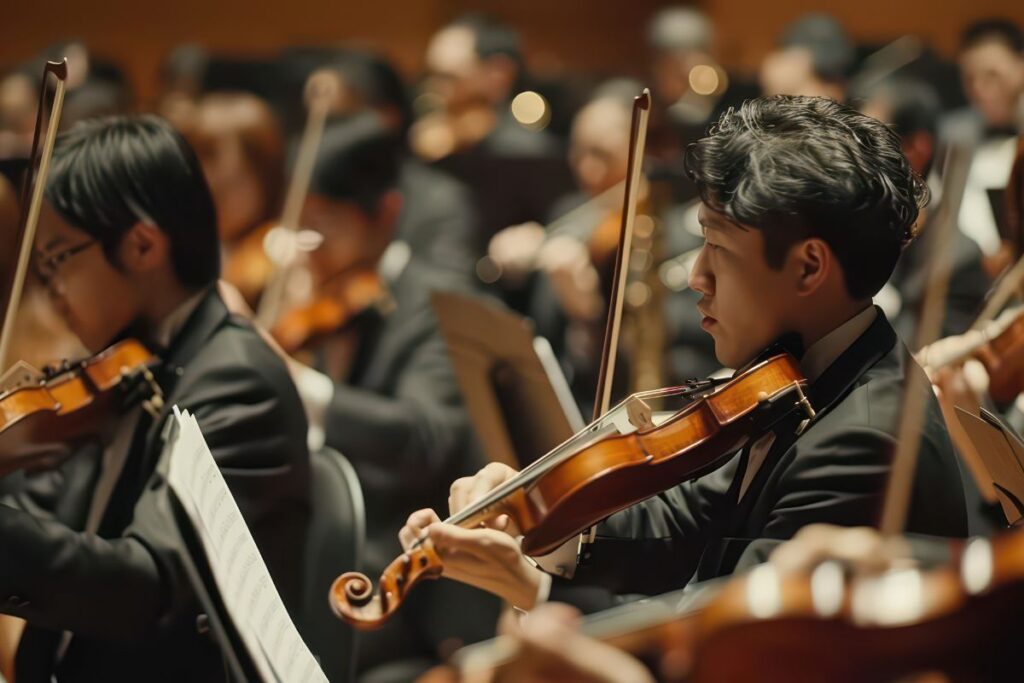
Certain pitfalls repeat themselves across violinists of every age. Recognizing them early saves months of frustration.
- Skipping the slow practice. Players who only run pieces at performance tempo never develop the precision needed for clean intonation.
- Gripping the bow. A tight bow grip kills tone. Frequent reminders to let the fingers and shoulders relax are essential, especially for children.
- Neglecting tuning. Students who do not learn to tune their own instrument never fully develop their ear. Build this habit from the very first months.
- Practicing in front of mirrors only when convenient. A small mirror or phone camera reveals posture issues that even good teachers miss in a weekly lesson.
- Comparing siblings or classmates. Progress on the violin is rarely linear, and comparisons usually discourage rather than motivate.
Joining Orchestras, Recitals, and Performance Opportunities
One of the great gifts of the violin is how naturally it leads to ensemble playing. Singapore is rich in community orchestras, chamber groups, and school string ensembles. Encourage your child, or yourself, to seek these out as soon as you have the basics in place. Playing alongside others builds rhythm, listening, and confidence in ways no amount of solo practice can match. Even informal small groups, two or three friends playing duets at home, can transform a student’s relationship with the instrument.
Building a Long-Term Relationship with the Violin
The students who stay with the violin into adulthood are rarely the most talented at age seven. They are the ones who, somewhere along the way, came to feel that the instrument was theirs, not their parents’, not their teacher’s, not the syllabus’s. Protect that feeling. Let a child choose a piece they love every term, even if it is below their level. Let an adult occasionally spend an entire lesson on a fiddle tune rather than the next etude. Technique is the engine, but love of the instrument is the fuel.
Begin Your Violin Journey with Harmony & Pitch
At Harmony & Pitch, our violin teachers work with students from preschool through professional preparation, as well as with adult beginners who simply want to enjoy the instrument on their own terms. Whether your goal is your child’s first recital, a Grade 8 exam, or playing alongside friends in a community orchestra, we will guide you with patience and honesty. Our team includes performers and pedagogues with backgrounds in Suzuki, traditional, and blended methods, and we work closely with parents through the early years, where home practice habits make the biggest difference. Explore our violin & viola lessons in Singapore and take the first step today. The violin is a long road, but it is one of the most rewarding journeys you will ever take in music, and you do not have to walk it alone.