Piano
Piano Lessons Singapore: The Complete Guide for All Ages
If you have ever stood in front of a piano and wondered where to begin, you are not alone. In Singapore, piano lessons remain the most popular entry point into music for children, teens and adults. From a four-year-old discovering middle C for the first time to a working professional returning to the instrument after twenty years away, the piano holds a rare place in our musical culture: structured enough to build serious skill, expressive enough to bring genuine joy.
This guide is designed to answer the questions that most parents and adult learners ask before signing up – what lessons really look like, when to start, how to choose between exam pathways, what fees to expect, and how to find a teacher who is right for you. If you are searching for piano lessons in Singapore, treat this as your starting map.
Throughout this guide, we will move from the broad picture – why piano study still matters in modern Singapore – into the practical specifics: starting age, lesson formats, exam pathways, fees, school selection and home practice. Use it as a reference. Skim the sections that apply to you, bookmark the ones that do not yet.
Why Piano Lessons Remain Singapore’s Most Popular Music Choice
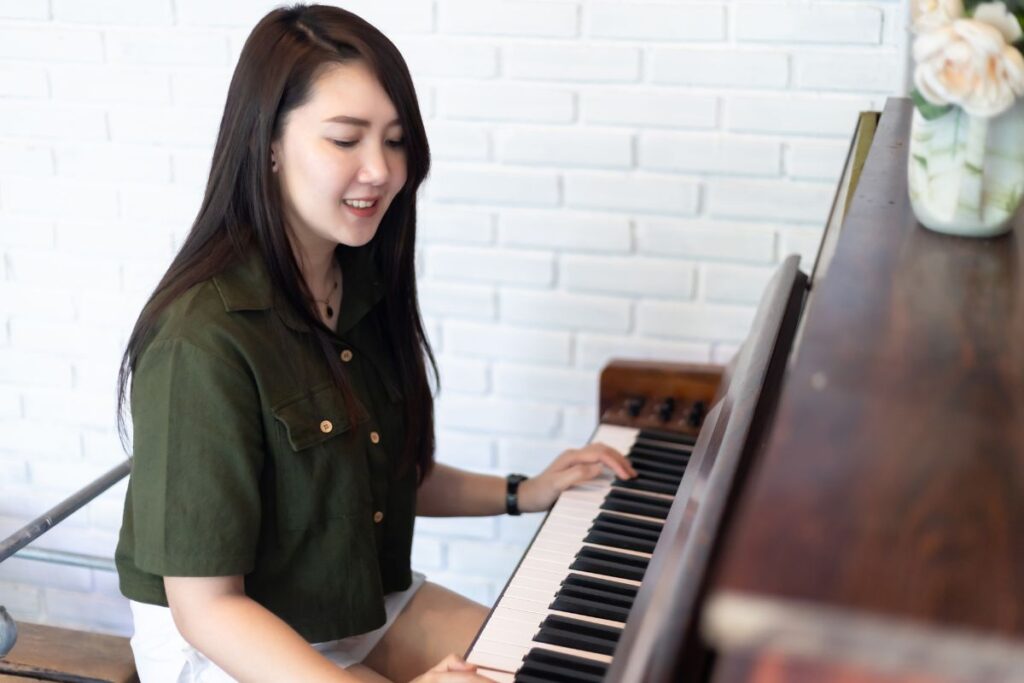
Walk through any HDB block on a weekday evening, and you will hear it: a Czerny exercise, a Burgmüller piece, the slow climb of a beginner scale. The piano is woven into Singaporean family life in a way few instruments are. There are three practical reasons for this.
- It is a complete instrument. Melody and harmony live together under your hands, which makes the piano an excellent first instrument and a strong foundation for any music you study later.
- Progress is visible early. Within a few months of focused practice, most beginners can play recognizable pieces, a powerful motivator for both children and adults.
- Exam and concert pathways are well established. Whether your goal is ABRSM Grade 8, a school audition, or simply playing for friends, the routes are clear and well supported.
Beyond the obvious skill-building, parents tell us that piano lessons quietly develop patience, listening, and concentration in ways that few other after-school activities can. These are the long-term reasons families stay with the instrument for years.
There is also a quieter cultural reason. In multi-generational Singaporean households, the piano is often the one instrument that grandparents, parents, and children all recognize as ‘real’ music study. That shared respect for the instrument means a young student often has built-in encouragement at home – aunts and uncles who notice progress, older relatives who remember their own piano lessons fondly, and parents who genuinely value the discipline of weekly attendance. None of this guarantees success, but it does build a warmer environment for learning.
What to Expect from Piano Lessons in Singapore Today
Modern piano lessons in Singapore look very different from the rigid one-hour sessions of a generation ago. A typical lesson today blends technical work, repertoire, theory, and creative play, scaled to the student’s age and goals.
- Warm-up and technique: scales, arpeggios, hand exercises, posture, and finger independence.
- Repertoire: classical pieces, contemporary works, film music, or pop arrangements, depending on interest.
- Musicianship: sight-reading, ear training, rhythm work, and basic music theory are built into the lesson.
- Creative work: improvisation, simple composition, or learning a song the student chose themselves.
Lessons typically run 30, 45, or 60 minutes. Young children often start with 30-minute sessions and extend as their focus and stamina grow. Adults usually do well with 45 to 60 minutes, which allows time to settle in and dig deeper into pieces.
Piano Lessons for Kids: When and How to Start
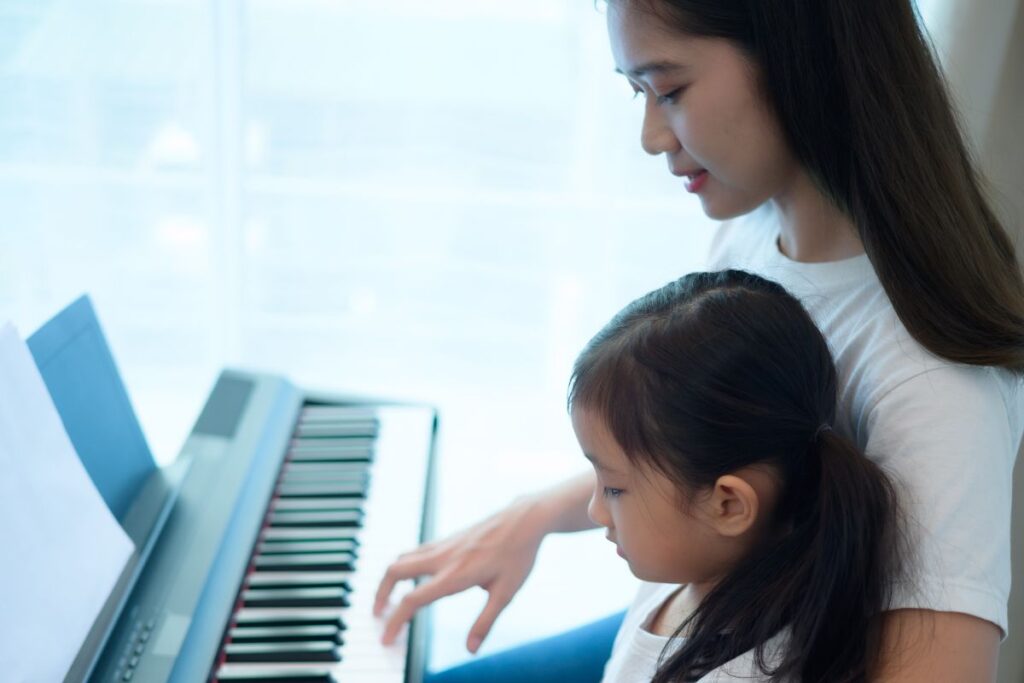
One of the most common questions we receive is the right age to begin piano lessons. The honest answer is that it depends less on age and more on readiness. Most children are ready between ages five and seven, but some thrive starting earlier with a teacher trained in early childhood music, and others benefit from waiting until seven or eight.
Signs a child is ready for structured piano lessons include:
- They can sit and focus on a single activity for fifteen to twenty minutes.
- They can follow simple multi-step instructions.
- They show curiosity about music – humming, asking about songs, or gravitating toward the piano at home.
- Their hands are large enough to comfortably span a five-note position.
For very young learners, lessons should feel like guided play. Games, stories, and movement are not distractions; they are how children learn music best. The technical discipline comes later, once the love of the instrument is already in place.
Piano Lessons for Teens: Building Discipline and Musical Identity
Teen years are often when piano study becomes more personal. Students who started young begin tackling intermediate to advanced grades, while new starters can make remarkable progress when they are genuinely motivated. The challenge at this stage is rarely ability – it is competing demands on time.
Good teachers help teens find their own musical voice. That might mean balancing exam repertoire with pieces from films, video games, or popular artists. It might mean exploring jazz, gospel, or worship-style playing. The aim is to keep practice meaningful when school pressure rises and reasons to quit start to multiply.
Piano Lessons for Adults: It’s Never Too Late to Begin
Adults who pick up the piano for the first time often expect it to be too late. It is not. Adult beginners typically progress faster than children on certain fronts – they understand theory more quickly, they read instructions more efficiently, and they show up to practice because they want to, not because they were told to.
What adult learners generally want from piano lessons:
- Play a favorite piece such as a Chopin nocturne, a Studio Ghibli theme, or a song from their wedding.
- Build a relaxing, creative practice outside work.
- Pick up where they left off as children after years away from the keys.
- Eventually accompany themselves or others when singing.
A teacher who works well with adults will respect your time, set realistic milestones, and calibrate technique to your hands and life, not to a textbook timeline.
Choosing Between ABRSM, Trinity, and Recreational Pathways
Most piano students in Singapore eventually face a choice: ABRSM, Trinity College London (TCL), or a non-exam track. None is universally better – the right pathway depends on the student’s goals and learning style.
- ABRSM is the most established system in Singapore. The repertoire leans classical, the structure is rigorous, and the grading is internationally recognized. A strong fit for students aiming for a deep classical technique.
- Trinity College London (TCL) offers more flexibility in repertoire choice, a separate Rock & Pop syllabus, and a marking scheme that some students find more encouraging. A strong fit for students who want a broader stylistic range.
- Recreational/non-exam learning is increasingly popular, especially among adult students. There is no syllabus pressure, and the curriculum is shaped around the music the student wants to play.
It is also perfectly normal to switch tracks. Many students take ABRSM exams up to a grade and then move into recreational study, or stop sitting exams once a personal milestone is reached. Exams are a tool, not a destination.
Group vs Private Piano Lessons: Which Is Right for You
Group classes can be a wonderful introduction for very young children, but private piano lessons remain the standard for serious progress beyond the early stages. The reason is simple: the piano is a personal instrument, and technique is built one hand position at a time. A skilled teacher cannot do that work for six students at once.
- Group lessons are best for early years music exposure, social motivation, and lower-cost entry.
- Private lessons are best for: structured progress, exam preparation, technique correction, and adult learners working around a busy schedule.
In-Person vs Online Piano Lessons in Singapore
Since 2020, online piano lessons have become a permanent part of the landscape. Both formats can work – the right choice depends on the student’s age, equipment, and goals. For a broader view, see our companion piece on the benefits of in-person vs online music lessons.
- In-person lessons remain ideal for young children, beginners, and exam preparation, where hands-on correction and acoustic feedback matter most.
- Online lessons suit busy adults, students traveling, and intermediate learners who already have solid fundamentals and a good acoustic or quality digital piano at home.
How Much Do Piano Lessons Cost in Singapore?
Piano lesson fees in Singapore vary widely based on the teacher’s qualifications, the lesson length, whether the lesson is private or group, and whether it takes place at a music school, the student’s home, or online. As a general guide, expect monthly fees to range from entry-level recreational pricing to higher rates for highly experienced performance-track teachers.
Beyond the lesson fee itself, parents and adult learners should budget for:
- Registration or material fees, where applicable.
- Exam fees if pursuing ABRSM or TCL.
- Sheet music and books.
- A piano or digital piano at home for practice.
We have a dedicated breakdown coming on what to expect from piano lesson fees in Singapore and why prices vary so much from school to school.
How to Choose the Right Piano School in Singapore
Singapore has no shortage of music schools, which is good news and a real headache at the same time. Use the following filters when shortlisting.
- Teacher quality and qualifications – look for performance diplomas, recognized pedagogy training, and a track record with the age group you are enrolling.
- Location and logistics – for children, a school close to home or school usually wins; for adults, online or near-office options often work better.
- Studio environment – a quiet, well-tuned room with a quality acoustic or premium digital piano matters more than glossy branding.
- Make-up lesson and rescheduling policy – practical, but easy to forget until you need it.
- Communication with parents: for younger students, regular feedback is essential.
What to Look for in a Qualified Piano Teacher
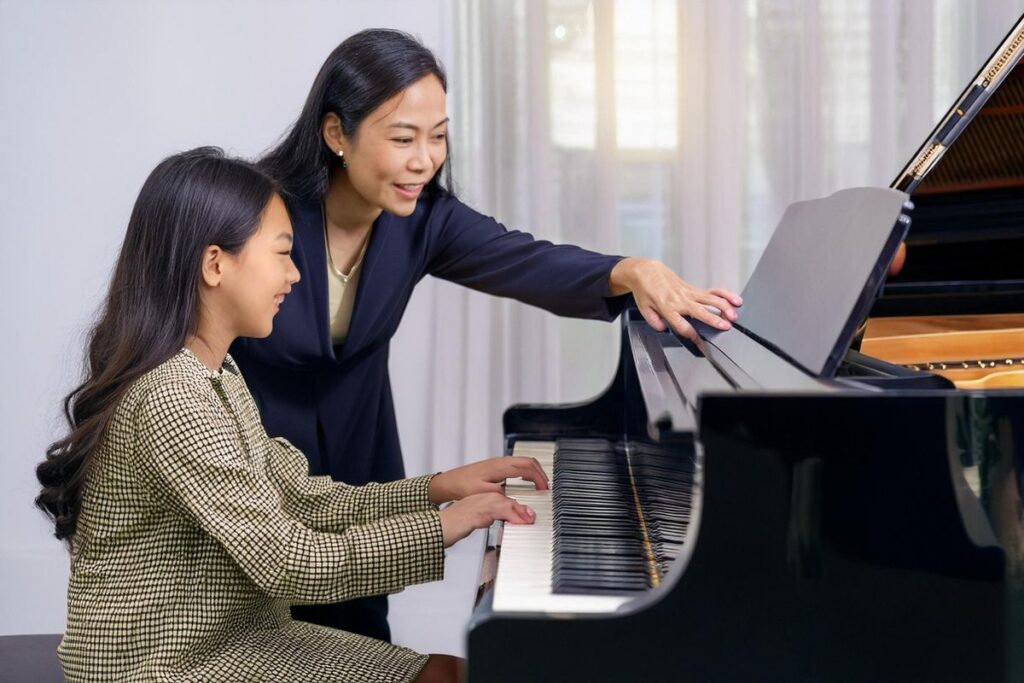
Qualifications matter, but they are not the whole picture. The best piano teachers combine musical credentials with the ability to teach a specific student in front of them. When you meet a prospective teacher, pay attention to these things:
- Do they ask about your goals, or do they jump straight into a sales pitch?
- Can they explain the technique in plain language, not jargon?
- Do they observe the student’s posture, hand shape, and tension before correcting anything?
- Are they patient with mistakes and clear about next steps?
Practicing at Home: Equipment, Routine, and Expectations
Lessons are where the learning happens, but practice is where progress lives. Without a consistent home routine, even the best teacher will struggle to move a student forward.
- Equipment: a full 88-key weighted instrument is the gold standard. A quality digital piano with weighted keys is a perfectly good starting point for beginners and intermediate students.
- Routine: shorter, daily sessions beat long weekend marathons. Twenty focused minutes a day is better than two hours on a Saturday.
- Environment: a quiet corner, a stable bench at the right height, and good lighting are non-negotiable.
- Expectations: progress is rarely linear. Plateaus are normal, and breakthroughs often follow patient repetition.
The Road Ahead: From First Lesson to Lifelong Musician
There is no single roadmap for a piano journey. Some students stop at Grade 5 and use their skills for personal enjoyment. Others go on to Grade 8, diplomas, music college, and performing careers. Many simply keep playing – for stress relief, for community, for the quiet pleasure of being able to sit down at the instrument and make something beautiful.
Whatever your destination, the early choices you make about teacher, school, and learning style will shape the road you walk. Choose carefully, but do not overthink – the most important step is the first one.
Piano Lessons in Bukit Timah and Around Singapore
Location plays a quiet but important role in whether piano study sticks. Families who choose a school close to home or close to a child’s school tend to attend more consistently, and consistency, more than talent, is what builds real progress. Bukit Timah has emerged as a popular hub for music education in Singapore, with a concentration of established schools, qualified teachers, and quiet studio spaces well suited to serious practice. For families further west, east, or in the north, look for a school whose weekly commute you can sustain through busy school terms, exam seasons, and the inevitable weeks where motivation dips.
Common Piano Lesson Mistakes (and How to Avoid Them)
Over the years, we have seen the same handful of stumbles repeat themselves in piano students of all ages. Most are easy to fix once you know to watch for them.
- Skipping scales and technique. They feel boring, but they are what make hard pieces playable. Five minutes a day pays off within weeks.
- Practicing only the easy parts. Most students replay sections they already know and avoid the bars that need real work. Identify the hardest two bars in your current piece and start there.
- Practicing too fast. Speed hides errors. Slow practice exposes them – and exposes them so they can be fixed.
- Inconsistent piano time at home. Twenty minutes a day, five days a week, will outperform a single two-hour Saturday session every time.
- Comparing children to other students. Every student progresses on their own timeline. Compare a child only to who they were three months ago.
Building a Long-Term Relationship with the Instrument
The students who keep playing into adulthood are rarely the ones who were pushed hardest. They are the ones who developed, somewhere along the way, a sense that the piano belonged to them – not to their parents, not to their teacher, not to an exam syllabus. Protect that feeling. Let your child learn a piece they choose every term, even if it is not on any syllabus. Let an adult learner sometimes spend a whole lesson on a song that means something to them. The technical foundation matters, but the relationship is what lasts.
Begin Your Piano Journey with Harmony & Pitch
At Harmony & Pitch, we have spent years guiding piano students of all ages through their first chords, exams, and performances. Whether you are looking for piano classes for your child, returning to the keyboard as an adult, or preparing for ABRSM or TCL exams, our team is here to help. Our teachers hold performance and pedagogy qualifications, take a genuine interest in each student’s musical goals, and work closely with parents on the journey of young learners. Lessons can be arranged in-person at our Bukit Timah studio or online for students with established fundamentals. Explore our piano lessons in Singapore and take the first step toward making music that feels truly your own. Whether your destination is Grade 8, your own composition, or simply playing for the love of it, we would be honored to walk that road with you.